


Green Tea Fermentation, How to Brew Matcha Kombucha & Jun Tea?

Most guides on green tea fermentation throw together a basic recipe and call it a day. That is not what this is.
This guide is built on deep knowledge of Japanese green tea, from how the leaf is grown to how it transforms inside a fermentation vessel. We cover everything: the science, the process, the tools, the mistakes, and the results you can actually expect.
At Hinomaru Cha, we source and supply premium Japanese matcha directly from Aichi Prefecture. We know this tea at a molecular level. And that expertise shapes everything we share here.
What Is Green Tea Fermentation?
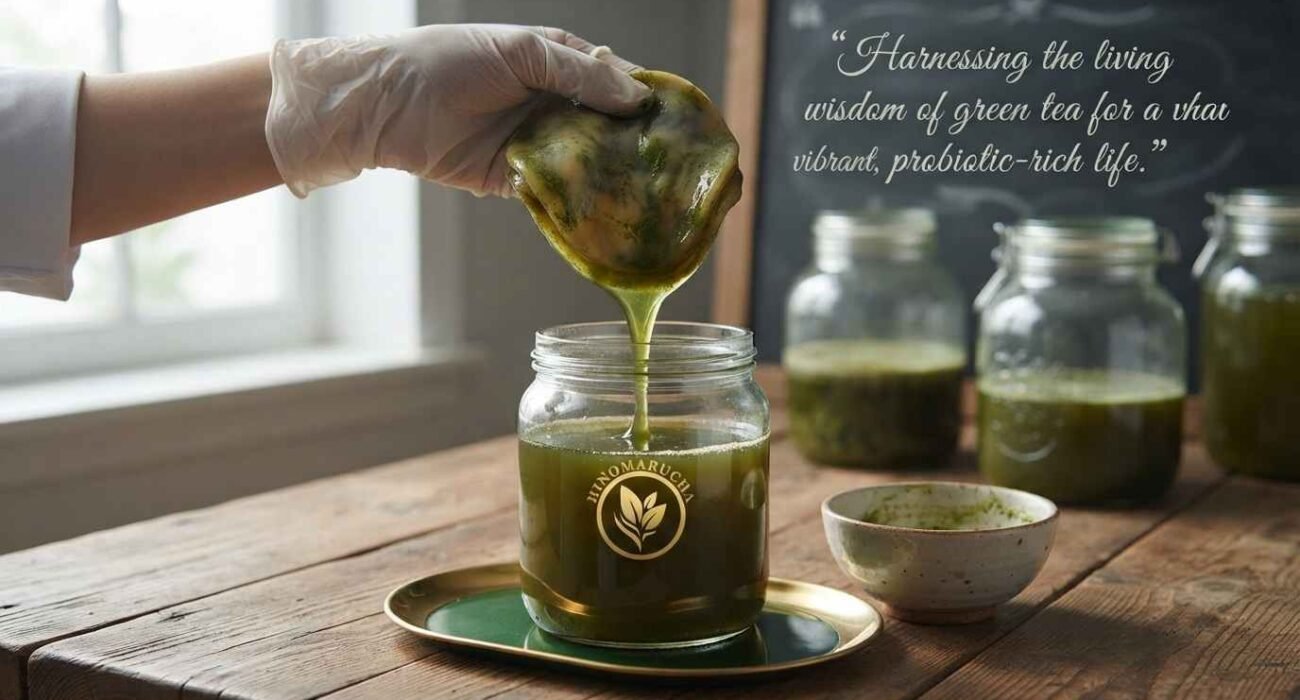
Green tea fermentation is the process of using a live culture, bacteria and yeast, to transform brewed green tea into a tangy, probiotic-rich drink.
The most common results are kombucha and jun tea.
Both drinks use a SCOBY (Symbiotic Culture of Bacteria and Yeast). Both produce organic acids, B vitamins, and probiotics during fermentation. But there are key differences.
| Feature | Kombucha | Jun Tea |
| Tea base | Black tea (traditionally) | Green tea |
| Sweetener | White or cane sugar | Raw honey |
| SCOBY type | Standard kombucha culture | Jun culture (honey-adapted) |
| Fermentation temp | 68–78°F (20–26°C) | 70–75°F (21–24°C) |
| Flavor profile | Bold, tangy, acidic | Lighter, floral, delicate |
| Caffeine level | Moderate to high | Low to moderate |
| Probiotic content | High | High |
| Brewing time | 7–14 days | 5–10 days |
Green tea changes the outcome significantly. It is lighter in tannins than black tea. That means the final drink has a cleaner, more delicate flavor. It also carries its own antioxidants, EGCG, catechins, and L-theanine, into the fermentation vessel.
Does green tea fermentation destroy those antioxidants?
No. Research shows that fermentation can actually enhance the bioavailability of certain polyphenols. The organic acids produced during the process help break down cellular walls, releasing compounds that are harder to absorb in plain tea. A 2019 study published in the Journal of Food Science found that fermented green tea retained over 70% of its original catechin content after 14 days of fermentation.
That is the starting point. Now let us go deeper.
Why Use Matcha for Green Tea Fermentation?
Most kombucha brewers use loose-leaf or bagged green tea. Matcha takes the process to a different level.
Matcha is powdered whole-leaf green tea. When you brew with it, you consume the entire leaf, not just a water extraction. This means the SCOBY has access to a denser nutrient profile. More chlorophyll. More amino acids. More EGCG.
The result is a matcha kombucha that is:
- Deeper green in color
- Higher in L-theanine (the calming amino acid)
- Richer in chlorophyll
- Slightly earthier in flavor
The challenge is that matcha can interfere with SCOBY growth if used in too high a concentration. We cover the correct ratios below.
Which grade of matcha should you use for fermentation?
Use culinary-grade matcha for fermentation. Ceremonial-grade matcha is best reserved for drinking directly, its delicate umami notes are partly lost in a multi-week ferment. Culinary grade still delivers excellent antioxidant content at a more practical price point.
That said, the quality of your culinary matcha still matters. A low-grade, oxidized powder will produce a dull, bitter ferment. Look for vibrant green color and a fresh grassy smell. Learn how to spot authentic quality here.
The Science Behind Green Tea Fermentation
Understanding the biology helps you brew better.
What Happens Inside the Vessel
When you add a SCOBY to sweetened green tea, several processes begin simultaneously:
- Yeast consumes sugar → produces ethanol and CO₂
- Acetobacter bacteria consume ethanol → produces acetic acid (the vinegar tang)
- Lactobacillus bacteria → produces lactic acid (smooth, creamy notes)
- B vitamins synthesize from bacterial metabolism
- Organic acids accumulate → drop the pH below 3.5 (preserving the drink naturally)
The entire process is anaerobic on the inside, aerobic on the surface. The SCOBY grows at the liquid’s surface, forming a new pellicle layer with each batch.
Why Temperature Matters?
| Temperature Range | Effect on Fermentation |
| Below 65°F (18°C) | Very slow, risk of mold |
| 68–75°F (20–24°C) | Ideal, balanced acid and carbonation |
| 75–80°F (24–27°C) | Faster ferment, more acidic result |
| Above 85°F (29°C) | Harmful to SCOBY, bitter flavor |
Green tea is more sensitive to heat than black tea. Keep your brewing environment consistent.
What Makes Jun Tea Different at a Cellular Level
Jun tea uses honey instead of sugar. Honey is not just a sweetener, it is itself a complex substance containing enzymes, hydrogen peroxide, and antimicrobial compounds.
The jun SCOBY has adapted over generations to tolerate honey’s antimicrobial properties. A standard kombucha SCOBY cannot thrive in raw honey. If you try to substitute honey into a regular kombucha brew without a true jun culture, the results will be inconsistent or the SCOBY may weaken.
This is why sourcing a genuine jun culture matters.
What You Need, Equipment and Ingredients
Equipment List
| Item | Purpose | Notes |
| 1-gallon glass jar | Primary fermentation vessel | Never use metal, acids corrode it |
| Cloth cover or coffee filter | Allows airflow, blocks contaminants | Secure with a rubber band |
| Wooden or plastic spoon | Stirring | No metal near the SCOBY |
| pH strips or meter | Monitor acidity | Target pH 2.5–3.5 at end |
| Thermometer | Temperature monitoring | Digital is most accurate |
| Bottles for second fermentation | Carbonation | Flip-top or swing-top glass bottles |
| Kitchen scale | Accurate ingredient ratios | Essential for matcha measurement |
| Fine mesh strainer | Remove SCOBY and solids | Stainless steel is fine here |
For whisking matcha before adding to the brew, a proper bamboo chasen creates a smooth suspension without clumps. Clumped matcha can settle in unwanted spots during fermentation. You can also learn how to use a chasen properly to get a lump-free mixture every time.
Ingredients for Matcha Kombucha (1-Gallon Batch)
| Ingredient | Amount | Notes |
| Filtered water | 14 cups | Chlorine-free |
| Culinary matcha powder | 2–3 tsp | Sifted, high quality |
| White cane sugar | 1 cup (200g) | Plain white, not coconut or raw |
| Kombucha SCOBY | 1 active SCOBY | Plus 1–2 cups starter liquid |
| Plain green tea (loose or bag) | 4 tsp / 4 bags | As the main base |
The matcha supplements the plain green tea, it does not replace it entirely. A 30/70 matcha-to-green-tea ratio works well for beginners.
Ingredients for Jun Tea (1-Gallon Batch)
| Ingredient | Amount | Notes |
| Filtered water | 14 cups | Room temperature to start |
| High-quality green tea | 4–5 tsp loose | Light-steamed varieties work best |
| Raw honey | 1 cup (340g) | Never use pasteurized honey |
| Jun SCOBY | 1 active jun culture | Plus 1 cup starter jun liquid |
Important: Add honey only after the tea has cooled below 90°F. Heat destroys honey’s live enzymes and beneficial compounds, the very things that make jun tea special.
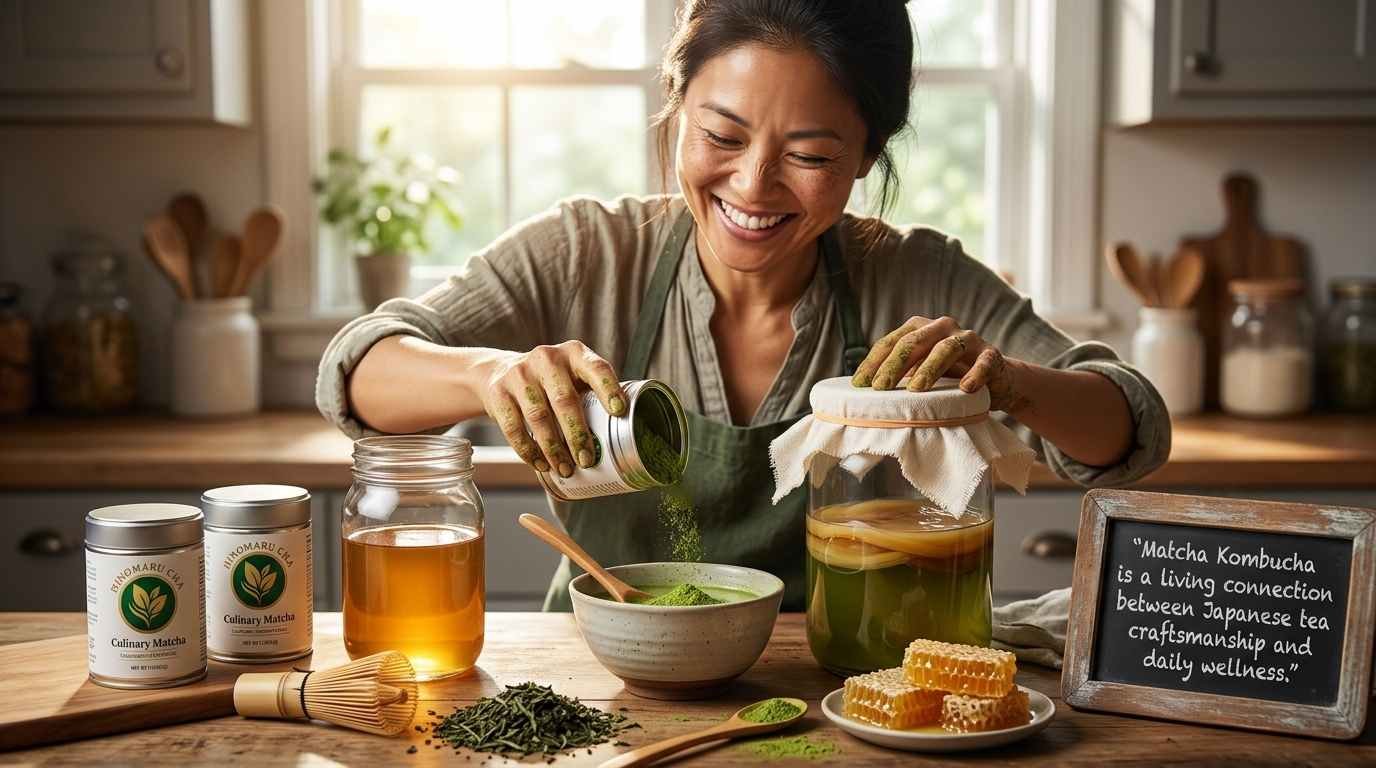
Step-by-Step: How to Make Matcha Kombucha
Step 1: Brew the Tea Base
Bring 4 cups of filtered water to 175°F (80°C). Do not boil, boiling water damages green tea’s delicate compounds.
Steep green tea for 3 minutes. Remove tea bags or strain loose leaf.
While the tea is still warm (not hot), sift matcha powder into a small bowl. Add 2–3 tablespoons of the warm tea. Whisk vigorously until smooth. Add the matcha mixture back to the tea.
Step 2: Dissolve the Sugar
Add 1 cup of white sugar to the warm tea. Stir until fully dissolved. Do not leave undissolved sugar, it can create off-flavors.
Step 3: Cool the Tea
Add remaining cold filtered water to bring the total to about 14 cups. Wait until the mixture reaches room temperature, below 85°F (29°C). This step is non-negotiable. A hot liquid will kill your SCOBY.
Step 4: Add the SCOBY and Starter Liquid
Pour the cooled tea into your clean glass jar. Add 1–2 cups of starter liquid (previously fermented kombucha) first. This immediately lowers the pH, protecting against contaminants. Then gently slide the SCOBY in.
Step 5: Cover and Ferment
Cover the jar with a breathable cloth. Secure with a rubber band. Place in a warm spot away from direct sunlight. Keep temperature between 68–78°F.
Fermentation timeline:
| Day | What to Expect |
| 1–2 | SCOBY settles, small bubbles may appear |
| 3–5 | Slight tang develops, SCOBY thickens |
| 7 | Taste-test, should be mildly tart |
| 10–14 | Fully fermented, tangy and complex |
Taste daily from day 7. When it reaches your preferred balance of sweet and sour, it is ready.
Step 6: Second Fermentation (for Carbonation)
Remove the SCOBY and set aside with 1–2 cups of liquid (your next starter).
Bottle the kombucha in flip-top glass bottles. Add flavor if desired (ginger slices, citrus peel, berry juice). Seal tightly. Leave at room temperature for 2–4 days.
Open carefully. CO₂ builds up. Burp the bottles daily to check pressure.
Refrigerate after desired carbonation is reached. The cold halts fermentation.
Step-by-Step, How to Brew Jun Tea?
Jun tea is gentler in flavor than kombucha. It suits people who prefer a lighter, more floral probiotic drink.
Step 1: Brew Light Green Tea
Heat water to 170°F (76°C). Steep 4–5 teaspoons of loose green tea for 2–3 minutes. Strain and let cool.
For best results, choose a high-quality Japanese green tea with a light, grassy character. The tea’s natural sweetness complements honey beautifully.
Step 2: Add Honey at the Right Temperature
Wait until the tea cools below 90°F (32°C). Add 1 cup of raw honey. Stir gently until fully dissolved.
Never rush this step. Honey added to hot tea becomes pasteurized honey, its live properties are destroyed.
Step 3: Add Water, SCOBY, and Starter
Add remaining cool water to reach 1 gallon total. Add your starter jun liquid first, then the jun culture.
Step 4: Ferment for 5–10 Days
Jun ferments faster than standard kombucha. Taste from day 5. The flavor should be light, mildly sour, with floral honey notes.
Step 5: Bottle and Optionally Carbonate
Bottle as with kombucha. Add elderflower, lavender, or citrus for layered flavor. Jun produces natural carbonation during second fermentation, give it 2–3 days at room temperature.
Matcha Kombucha vs. Jun Tea, Full Comparison
| Category | Matcha Kombucha | Jun Tea |
| Flavor | Earthy, tangy, slightly grassy | Light, floral, mildly sweet |
| Brewing time | 10–14 days | 5–10 days |
| Difficulty | Moderate | Moderate |
| Cost per gallon | Lower (sugar-based) | Higher (raw honey) |
| SCOBY availability | Widely available | Harder to find |
| Caffeine | Moderate (green tea + matcha) | Low to moderate |
| Probiotic richness | High | High |
| Best for | Antioxidant boost, bold flavor | Gentle gut support, lighter taste |
| Second fermentation | Yes | Yes |
| Shelf life (refrigerated) | 2–3 months | 2–3 months |
Pros and Cons
Matcha Kombucha
| Pros | Cons |
| Higher antioxidant density | Matcha can cloud the SCOBY layer |
| Richer in EGCG | Slightly more complex to prepare |
| Wide SCOBY availability | Matcha must be whisked well first |
| More affordable per batch | Not ideal for those sensitive to caffeine |
Jun Tea
| Pros | Cons |
| Delicate, complex flavor | Jun cultures are rare and expensive |
| Live enzymes from raw honey | Raw honey costs more than sugar |
| Faster fermentation cycle | Cannot use regular kombucha SCOBY |
| Very gentle on the digestive system | Temperature management more critical |
Health Benefits of Green Tea Fermentation
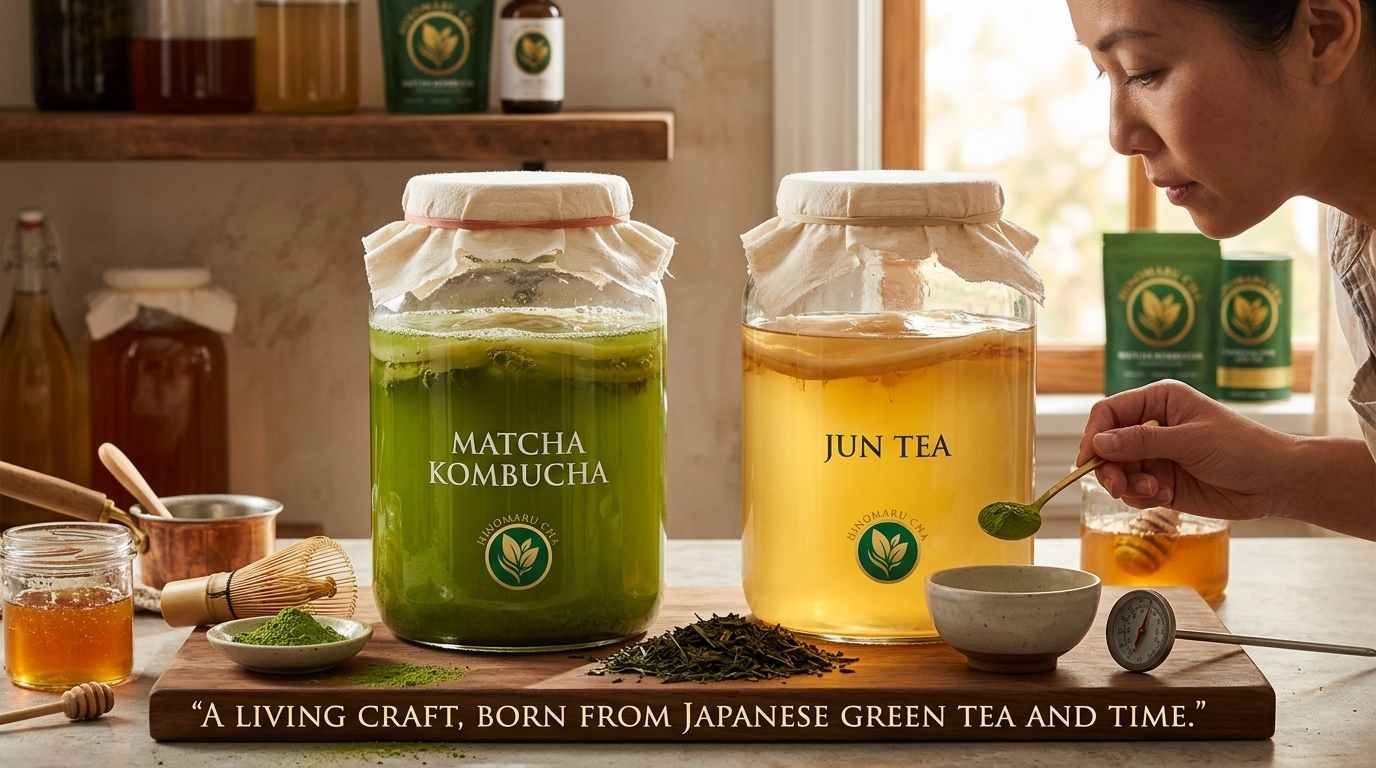
Both matcha kombucha and jun tea deliver measurable health support. Here is what the evidence shows:
Probiotic Content
Fermented green tea drinks contain live cultures of Acetobacter, Gluconobacter, and Lactobacillus species. These contribute to gut microbiome diversity, a key factor in immune function, mood regulation, and inflammation control.
A 2021 meta-analysis in Frontiers in Microbiology found that regular consumption of fermented beverages was associated with improved gut barrier function in 82% of studies reviewed.
Antioxidant Delivery
Green tea is one of the most antioxidant-dense beverages on earth. Fermentation does not destroy this. EGCG (epigallocatechin gallate) survives fermentation and may become more bioavailable as the pH drops.
Matcha specifically adds:
- Chlorophyll, supports detoxification pathways
- L-theanine, promotes calm focus without sedation
- EGCG, anti-inflammatory, metabolic support
- Catechins, cardiovascular and cellular protection
Organic Acid Benefits
The fermentation process produces:
- Acetic acid, antimicrobial, supports blood sugar regulation
- Lactic acid, supports gut lining integrity
- Glucuronic acid, supports liver detoxification
Digestive Support
The enzymes and acids in fermented green tea help break down food more efficiently. Many people report reduced bloating and improved digestion within 2–3 weeks of regular consumption.
Important disclaimer: These statements are based on published research. This guide does not constitute medical advice. Consult a healthcare provider if you have specific health conditions.
Common Mistakes in Green Tea Fermentation (and How to Fix Them)
We have seen these mistakes repeated across dozens of brewing communities. Avoid them.
Mistake 1: Using Boiling Water With Green Tea
What happens: Destroys catechins and denatures the flavor. Produces a bitter, flat brew. Fix: Keep water at 170–180°F (76–82°C) for green tea.
Mistake 2: Adding SCOBY to Hot Tea
What happens: Kills the live cultures. Your ferment will fail silently. Fix: Always cool your sweetened tea below 85°F before adding SCOBY and starter liquid.
Mistake 3: Using Metal Utensils or Containers
What happens: Organic acids corrode metal, leaching particles into your drink. Also weakens the SCOBY. Fix: Use glass, ceramic, or food-grade plastic. Wooden or plastic spoons only.
Mistake 4: Skipping the Starter Liquid
What happens: The initial pH is too high, creating a window for mold and contamination. Fix: Always use 1–2 cups of finished kombucha or jun as starter. This is your insurance.
Mistake 5: Too Much Matcha in the Base
What happens: High concentrations of matcha can inhibit SCOBY growth by introducing too many tannins. Fix: Keep matcha at 2–3 teaspoons per gallon. Supplement with plain green tea for the bulk of the base.
Mistake 6: Fermenting in Direct Sunlight
What happens: UV light damages the culture and heats the vessel unevenly. Fix: Ferment in a dark cupboard or cover the jar with a cloth.
Mistake 7: Not Tasting During Fermentation
What happens: Over-fermented kombucha becomes vinegar-sharp. Under-fermented tastes flat and too sweet. Fix: Taste daily from day 7. Use a clean straw inserted under the cloth, never contaminate with dirty utensils.
Flavoring Ideas for Green Tea Kombucha and Jun

The second fermentation is where creativity comes in. Here are flavor combinations that work particularly well with green tea bases:
| Flavor Profile | Add to Bottle | Notes |
| Citrus + Ginger | Lemon zest + ginger slices | Classic, digestive |
| Floral | Dried lavender + honey | Works beautifully with jun |
| Tropical | Mango chunks + lime | Bright, summery |
| Berry | Blueberry + lemon | Rich color, antioxidant boost |
| Matcha + Vanilla | Pinch of matcha + vanilla bean | Layered, complex |
| Mint + Cucumber | Fresh mint + cucumber slice | Refreshing, light |
For inspiration on how matcha pairs with other flavors, see how it works in drinks like banana matcha latte and lavender matcha latte, those flavor logic principles translate well into second ferments.
How Matcha Quality Shapes Your Ferment?
This is a point most fermentation guides skip entirely. We don’t.
The quality of your matcha directly affects the quality of your fermented drink. Here is why:
Freshness Matters
Matcha oxidizes quickly once the bag is opened. Oxidized matcha is dull, brownish, and bitter. When you ferment with it, those off-notes get concentrated, not diluted. Always use fresh matcha stored properly.
Learn the best ways to store matcha to protect your investment and your brew.
Origin Matters
Japanese matcha is grown under strict shading protocols that boost L-theanine and chlorophyll. Chinese matcha, while cheaper, typically lacks the same nutrient density. Since these compounds carry into your ferment, origin affects both nutrition and flavor.
Aichi Prefecture matcha is particularly prized for its balanced umami-sweetness profile, a flavor character that adds a pleasant depth to green tea fermentation.
Grinding Method Matters
Authentic stone-ground matcha retains more volatile aromatics and breaks down more finely. Spray-dried or ball-milled matcha behaves differently in liquid, it tends to settle faster and integrate less evenly. How matcha goes from tencha leaves to powder explains the full production chain.
What to Look for in Your Matcha
| Quality Indicator | Good Sign | Red Flag |
| Color | Vivid, bright green | Yellow, olive, or brown tones |
| Aroma | Fresh, grassy, slightly sweet | Dusty, flat, or fishy |
| Texture | Very fine, silky | Gritty, clumpy |
| Taste (raw) | Umami, sweet, slight bitterness | Harsh bitterness, no sweetness |
| Origin | Japan (verified) | Unlabeled or blended |
Our Hinomaru Cha Ceremonial Grade Aichi Matcha meets every one of these indicators. It is stone-ground, single-origin, and packed in airtight containers to preserve freshness from farm to fermentation vessel.
Hinomaru Cha, Why Serious Brewers Choose Our Matcha?
We do not just sell matcha. We source it directly from Japan’s Aichi Prefecture, one of the most respected growing regions for premium tea.
Here is what sets our sourcing apart:
Direct Farm Relationships
Most matcha brands source through intermediaries. We work directly with Japanese tea farmers. That means fresher product, traceable origin, and consistent quality from batch to batch.
Rigorous Quality Standards
Our matcha goes through multiple quality checks before it reaches you. Color, particle size, moisture content, and flavor profile are all evaluated. How freshness shapes true ceremonial matcha quality walks through exactly what we look for.
Sustainable Farming Practices
We partner with farms committed to sustainable, responsible growing. Sustainable matcha farming practices in Japan explores how this affects the leaf, and by extension, your ferment.
Small-Batch Production
We prioritize small-batch, freshly ground orders. Large batches sitting in warehouses oxidize. Ours don’t. How small-batch production preserves matcha freshness explains why this matters for every cup, and every fermentation batch.
Packaging Built for Freshness
Our Screw Can with Pull-Top and Mini Top Can are engineered for airtight, light-resistant storage. Matcha’s enemies are air, light, heat, and moisture. Our packaging fights all four.
For those who want to explore our full product lineup, from artisan Geisha cans to Mt. Fuji collector tins, every container is selected to protect quality from our farm partners to your brewing vessel.
Fermentation Troubleshooting Chart
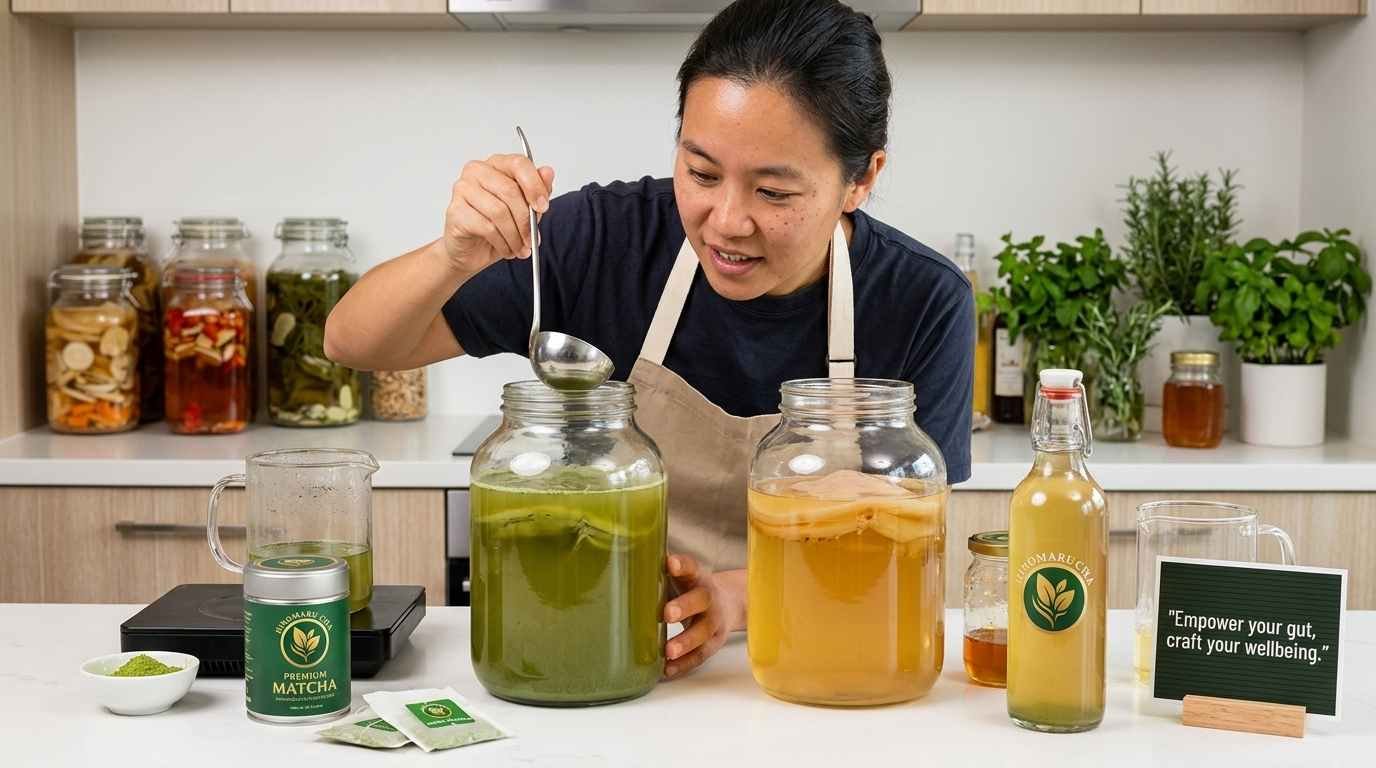
| Problem | Likely Cause | Solution |
| Mold on SCOBY (fuzzy, colored) | Too little starter liquid, contamination | Discard everything. Start fresh with proper sanitation |
| Flat, no carbonation after 2nd ferment | Bottles not sealed, not enough residual sugar | Use flip-top bottles; leave slightly more sweetness before bottling |
| Too sour / vinegar taste | Over-fermented | Ferment fewer days; taste more often |
| Too sweet | Under-fermented | Allow more days in primary fermentation |
| SCOBY sinking | Normal behavior | SCOBYs sink, float, and tilt, all normal |
| Brown streaks in SCOBY | Yeast strands | Normal, does not affect quality |
| Cloudy kombucha | Yeast and bacteria in suspension | Normal, shake gently before drinking |
| Bitter matcha flavor | Too much matcha, or oxidized matcha | Reduce matcha ratio; use fresher powder |
| No new SCOBY forming | Temperature too low or SCOBY too old | Warm environment; replace with a fresh culture |
Storing Your Finished Green Tea Kombucha and Jun
Refrigerate immediately after reaching desired flavor and carbonation. Cold slows fermentation to near zero.
- Shelf life (sealed bottle): 2–3 months in the refrigerator
- After opening: Consume within 1–2 weeks
- Signs it has gone bad: Off smell (sulfuric or putrid), visible mold, or extreme vinegar taste beyond normal acidity
Your SCOBY hotel, a jar of SCOBYs stored in starter liquid, can last months in the refrigerator. Feed it every 4–6 weeks with fresh sweetened tea.
Scaling Up, From Home Brew to Small Batch Production
Many home brewers eventually ask: can this scale?
Yes, but scaling kombucha production requires attention to:
- Vessel size and airflow ratios
- Consistent temperature control
- pH monitoring at every stage
- Sanitation protocols
- Consistent matcha sourcing
For those exploring matcha as a business ingredient, our wholesale matcha guide and how to start a matcha business with a Japanese supplier walk through the supply chain in detail.
Consistent sourcing is the foundation of a consistent product. What to look for in a reliable matcha wholesale partner covers exactly what questions to ask before committing to a supplier.
Green Tea Fermentation, Quick Reference Statistics
| Metric | Value | Source |
| Average pH of finished kombucha | 2.5–3.5 | Food Chemistry, 2020 |
| EGCG retention after 14-day ferment | ~70% | Journal of Food Science, 2019 |
| Probiotic CFU per 8oz serving | 1–3 billion (varies) | NCBI Review, 2021 |
| Typical alcohol content in kombucha | 0.5–3% | FDA Guidelines |
| L-theanine in matcha vs. other green teas | 3–4x higher | USDA Tea Database |
| Recommended daily intake | 4–8 oz for beginners | Fermentation practitioners consensus |
| Brewing time (matcha kombucha) | 10–14 days (1st ferment) | Standard practice |
| Second fermentation time | 2–4 days | Standard practice |
Green Tea Fermentation as a Daily Wellness Practice

Home brewing is not just a hobby. It is a way to take ownership of what you consume.
When you brew matcha kombucha or jun tea at home, you control every input. You choose the tea. You choose the sweetener. You decide when fermentation ends. You know exactly what is, and is not, in your bottle.
That is a form of nutritional literacy that store-bought drinks cannot offer.
Many of our customers start with a single bag of culinary matcha for brewing, then discover the broader world of Japanese green tea. They start exploring how Japan’s matcha became a global wellness staple. They begin to understand why origin, shade-growing, and stone-grinding produce something fundamentally different from commodity green tea.
Fermentation accelerates this discovery. It forces you to slow down, observe, and pay attention to quality. A bad batch teaches you more than a perfect one.
Start with one gallon. Taste it at day 7, day 10, and day 14. Compare the flavor evolution. Once you understand how it changes, you will never look at a $5 store-bought kombucha the same way.
Conclusion
Green tea fermentation is one of the most rewarding things you can do with premium Japanese tea.
It takes patience. It takes quality ingredients. It takes attention to temperature, timing, and sanitation. But when it works, and it will, you have a living, probiotic-rich drink with more nutritional depth than anything you will find on a shelf.
Matcha kombucha gives you the full-leaf nutrient profile of matcha, transformed and amplified by fermentation. Jun tea gives you a lighter, more floral experience that honors raw honey’s complexity.
Both start with one thing: exceptional green tea.
That is what Hinomaru Cha provides. Our matcha is stone-ground, single-origin, freshly packed, and backed by deep knowledge of how Japanese tea is grown, processed, and used. Explore the 5 key benefits of matcha and see why it matters for your health and your brew.
Whether you are brewing your first gallon or your fiftieth, the tea you choose shapes the drink you make. Choose wisely. Choose from the source.
Frequently Asked Questions
- What tea is best for green tea fermentation?
Light Japanese green teas like sencha or gyokuro work well. For matcha kombucha, use culinary-grade matcha at 2–3 teaspoons per gallon alongside plain green tea.
- Can I use matcha instead of regular green tea for kombucha?
Yes, but do not use matcha alone. Combine it 30/70 with plain green tea. Too much matcha inhibits SCOBY growth due to high tannin concentration.
- How long does green tea fermentation take?
Matcha kombucha takes 10–14 days for primary fermentation. Jun tea is faster at 5–10 days. Second fermentation adds 2–4 more days for carbonation.
- Does fermentation destroy the antioxidants in green tea?
No. Research shows that fermented green tea retains roughly 70% of its catechins. Some antioxidants become more bioavailable as fermentation acids lower the drink’s pH.
- What is the difference between kombucha and jun tea?
Kombucha traditionally uses black or green tea with cane sugar. Jun tea uses green tea and raw honey with a honey-adapted SCOBY culture, producing a lighter, more floral probiotic drink.